Introducing the Agentic Compute Platform (ACP)

March 12, 2026 — NYC Meetup
Last night, I introduced the Agentic Collaboration Platform (ACP) to a room full of curious technologists at the OpenClaw for your Startup meetup. The energy was electric, the questions were sharp, and the conversations afterward went well past closing time.
Here's what makes ACP different: Your data never leaves your AWS account. No SaaS vendor, no API keys sent to third parties, no data processing in someone else's cloud. You deploy ACP on your own infrastructure, and everything—your conversations, your code, your AI inference—stays under your control. This ensures complete privacy and data sovereignty.
What is ACP?
ACP is a self-hosted platform where humans and AI agents collaborate in real channels—not just chat windows, but structured workspaces with topics, threads, and @mentions. Think of it as your team's collaboration hub, except some of your teammates are AI agents with superpowers.
The platform has three key components:
(coming soon)
Built on AWS infrastructure with Amazon Bedrock for AI inference and PVM for secure, temporary IAM permissions.
Three Deployment Modes
Personal Mode — Your second brain, your personal assistant. This is for you if: You want to experiment with AI agents in a safe sandbox, or you need a powerful assistant that respects your privacy.
Team Mode — Organizational collaboration with workflow automation. This is for you if: Your engineering team wants AI-powered productivity without giving away your codebase or data to a SaaS platform.
Event Mode — Fully configurable for conferences, weddings, group travel, or any temporary coordination need. This is for you if: You're organizing a complex event and need a disposable coordination hub.
The Questions People Asked
The Q&A session revealed what people care about most:
"Is your second brain managing the memory?"
Yes — sBrain is the dedicated knowledge layer that gives agents persistent memory. It stores information from your conversations, tasks, and research, then surfaces the right context when an agent needs it. Instead of starting fresh on every task, agents draw on a shared, searchable long-term memory that grows smarter over time. The distinction matters: working memory is what an agent holds in mind right now; sBrain is what the platform knows permanently.
"Is Zulip configured specifically for this?"
Yes — ACP ships with a configuration and integration layer that connects Zulip directly to the OpenClaw agent runtime. Zulip is open source and self-hosted, so it fits naturally into ACP's data-sovereignty model: everything stays in your AWS account, including the chat platform itself. The structured channel/topic model keeps conversations organized and searchable, which is critical when agents and humans are collaborating in the same channels at the same time.
"How do you switch models?"
Slash commands in the agent's direct message channel. Tell your agent to use Claude Opus for deep reasoning, Haiku for quick responses, or any model available through Amazon Bedrock — no redeploy, no config change. It takes about two seconds. The ability to mix and match models on the fly is one of ACP's more practical advantages over locked-in SaaS AI tools.
Each agent's identity has a default model. So each session wakes up with the default model. Then you can use slash commands to switch mid-session, if you need to.
"Do the agents code for you?"
Yes. I typically work with two agents at a time—one doing the work, one managing the work. They call me when they need a decision; mostly I'm watching and directing from Zulip. I don't write code myself anymore. I orchestrate agents who write the code.
"One doing the work, one managing the work. I don't write code myself anymore; I orchestrate agents who write code."
"How is this running remotely on AWS?"
ACP runs on an EC2 instance with OpenClaw and Zulip installed side-by-side. The instance has an IAM role, so when it calls Amazon Bedrock for AI inference, authentication is handled automatically — no API keys to manage, no credentials to rotate or accidentally expose. That's a meaningful security advantage: your infrastructure authenticates itself, and your data never leaves your AWS account.
The Presentation Itself
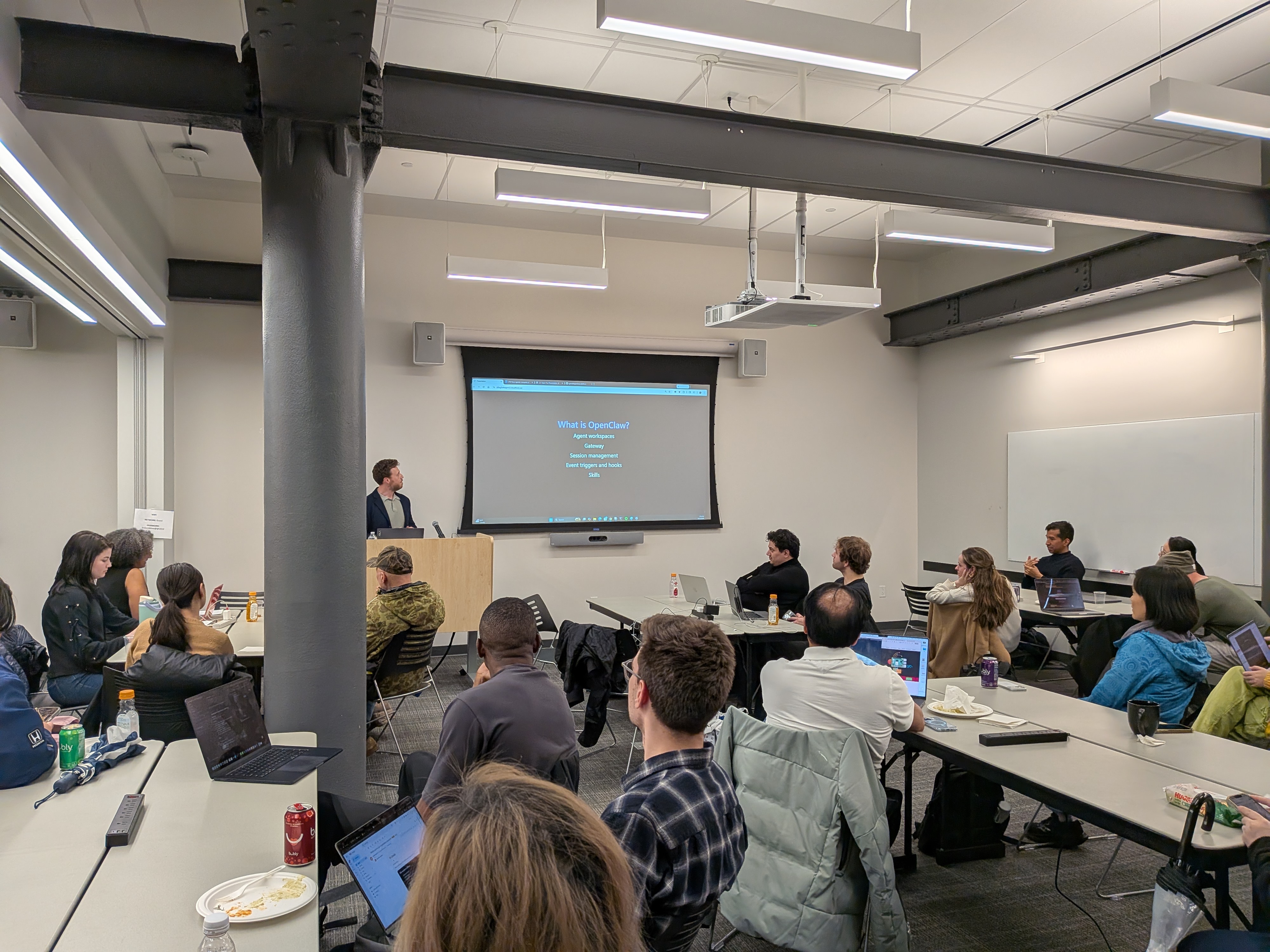
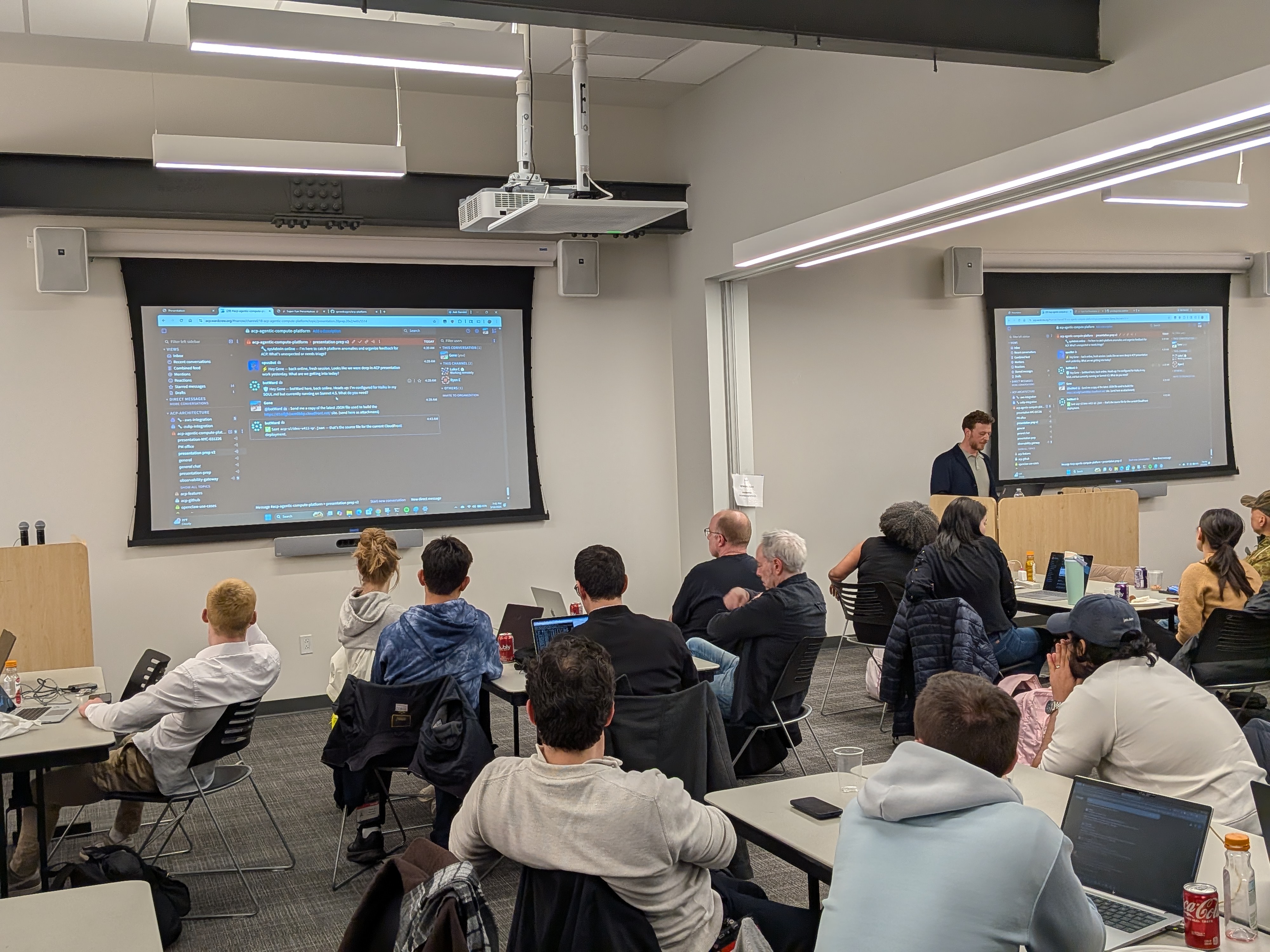
Here's the meta-irony that hit hardest: the presentation deck itself was built collaboratively with my agents over the previous hours—using a platform that OpenClaw helped me build over the previous week. We iterated through multiple versions, fixing typos, adjusting layouts, generating images, and even creating QR codes—all through natural conversation in Zulip channels.
By the time I stood in front of the room, the deck had been refined through dozens of agent interactions. I was presenting a platform for human-agent collaboration using a presentation that was itself the product of human-agent collaboration. The audience got it immediately.
To drive the point home, I asked botWard—live, in front of everyone—to generate a presentation with the most ridiculously colorful, over-the-top styling possible. The result was both absurd and functional: rainbow gradients, wiggling text, Comic Sans, and bouncing animations. The room erupted in laughter. It proved the point perfectly: when agents understand your tools this deeply, they can execute even the silliest requests in seconds.
Ready to Try It?
Deploy ACP on your own AWS account in under 20 minutes:
👉 Get Started: github.com/genedragon/acp-platformThe deployment process is straightforward if you have your AWS prerequisites in place. The documentation covers architecture, deployment, configuration, and security.
This is just the beginning. The platform is designed to be extended—new skills, new integrations, new deployment patterns.
Special Thanks
This event wouldn't have been possible without our incredible hosts and organizers:
And special thanks to our sponsors: Avahi and AWS.
Links
- GitHub Repository: genedragon/acp-platform
- Presentation Slides: View the deck
- Event Page: Luma event details
- Connect: LinkedIn